
What Causes Bloat, What Farmers Currently Use to Prevent It, and Where Flaxseed Oil Fits In
KEY TAKEAWAYS
- Molasses isn’t actually the anti-bloat/anti-foam agent, it’s merely the palatable carrier that the anti-bloat agent is mixed in.
- Molasses is high glucose meaning farmers need to account for those added carbs in the cattle’s diet.
- Flaxseed Oil is highly palatable to the cattle and acts as an essential anti-bloat agent needing no diet adjustments, no additional ‘active agent’, and providing Omega 3s, Omega 6s, and Omega 9s.
- Cattle will continue to get bloat as they have since day dot (60AD) – the easiest way to manage it is providing a highly palatable, natural/non-refined carrier oil i.e. Flaxseed Oil, to feed the anti-bloat agent to the cattle and that doesn’t require any any additional dietary adjustments.
What Bloat Actually Is
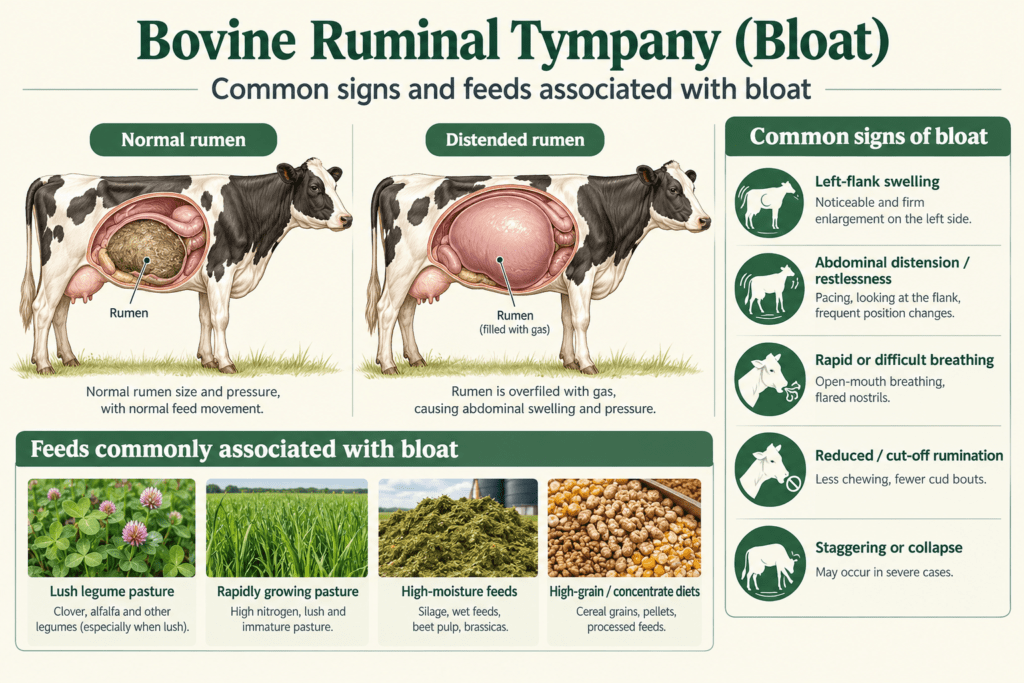
Bloat happens when gas produced during normal rumen digestion can’t escape through belching (eructation) and builds up instead. There are two forms:
- Frothy bloat — the more common pasture-related type. Gas gets trapped in a stable foam within the rumen liquid, rather than as a separate gas pocket, so the animal physically can’t burp it up. This is the type most associated with lush clover, lucerne, and other legume-heavy pastures.
- Free-gas bloat — gas accumulates as a distinct pocket, often due to an esophageal obstruction or something physically blocking normal eructation.
Left untreated, the distended rumen presses on the lungs and heart, and death is usually caused by suffocation — sometimes within hours of symptoms starting.
WHY IT HAPPENS: The Pasture Connection
In New Zealand and other pastoral systems, bloat is overwhelmingly linked to legume-dominant pasture, particularly white clover, red clover, and lucerne. Soluble leaf proteins in these plants create a stable foam in the rumen. Risk increases with:
- Lush, rapidly growing pasture (especially after rain or in spring)
- High clover content in a sward (clover levels above roughly 20% start increasing risk)
- Sudden diet changes — moving hungry stock onto rich pasture without any transition
- Dew or moisture on pasture at grazing time
- Discontinuous grazing (cattle removed from legume pasture overnight and put back on it, rather than grazing continuously)
Bloat risk also varies by breed: Jersey cattle, for instance, have historically shown greater susceptibility than Friesian or Ayrshire cattle, and there’s a genetic/family component on top of that.
Current Prevention Methods
Most farmers use a combination of approaches, since no single method is completely fool-proof. Here’s the landscape:
- Pasture and grazing management
- Filling hungry stock up on hay before turning them onto risky pasture
- Strip grazing, so cattle eat the whole plant rather than selectively grazing the highest-risk leaf material
- Avoiding grazing when there’s heavy dew or moisture on legume pasture
- Feeding grass hay or silage alongside pasture to add bulk and fibre
- Grazing continuously on legume pasture rather than restricting access, where practical as interrupted grazing has been shown to increase risk
- Bloat-resistant forage species
- Legumes containing condensed tannins such as sainfoin and birdsfoot trefoil bind to soluble proteins in the rumen and don’t cause the same stable foam that clover and lucerne do. Intermixing these into a pasture (even as a partial component) has been shown to meaningfully reduce bloat incidence, though persistence of these species in mixed pasture can be a challenge.
- Rumen modifiers (ionophores)
- Monensin (marketed as Rumensin) reduces bloat by changing the rumen’s microbial population, which lowers foam-producing gas production. It’s usually delivered as a slow-release capsule and needs 10–14 days to become effective, so it needs to be started ahead of the risk period. It doesn’t eliminate bloat entirely, and some animals respond better than others.
- Synthetic anti-foaming agents (detergents/surfactants)
- This is the most widely used category — products based on alcohol ethoxylates or similar surfactants (sold under names like Bloatenz, Bloataway, Teric, and various “bloat oil” brands) work by breaking down the foam so trapped gas can escape. These are delivered several ways:
- Drenching — directly dosing individual animals
- Water treatment — adding detergent to troughs (only works where troughs are the sole water source)
- Pasture spraying — spraying the active agent directly onto pasture before grazing
- Flank application — brushing oil onto the flank, which cattle then lick off themselves
- This is the most widely used category — products based on alcohol ethoxylates or similar surfactants (sold under names like Bloatenz, Bloataway, Teric, and various “bloat oil” brands) work by breaking down the foam so trapped gas can escape. These are delivered several ways:
- Molasses-based delivery
- Molasses itself isn’t generally the active anti-foaming ingredient. It’s used as a palatability carrier to get cattle to voluntarily consume synthetic surfactants like Teric, or to carry poloxalene (another anti-foaming compound) in a block or top-dress form. As one supplier puts it plainly: cattle will only eat some of these bloat oils voluntarily if they’re mixed with molasses in roughly equal proportions otherwise the oil isn’t palatable enough on its own.
NOTE: Molasses isn’t the active ingredient in fixing bloat
A lot of farmers reasonably assume the molasses itself is doing the anti-foaming work, when really it’s just there to mask the taste of the actual active ingredient and get consistent voluntary intake. The thing with Flaxseed Oil is that its cheaper and the cows lap it up – plus they get benefits of the ALA omega-3 and there’s no need to worry about high carb intake.
Where Flaxseed Oil Fits In – it could be the only agent you need!
Flaxseed (linseed) oil works as an effective, simple anti-foaming agent, breaking down the stable foam so gas can be released, but with one practical advantage over other bloat oils that’s been noted specifically in New Zealand beef finishing systems: it’s genuinely palatable to cattle in a way that most other bloat oils aren’t.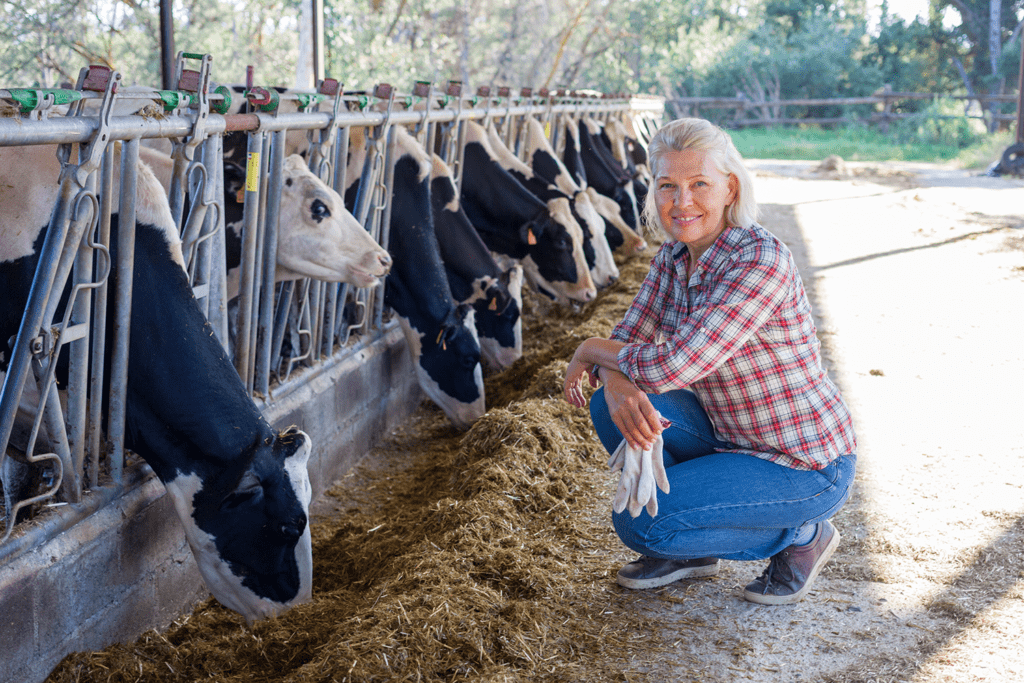 In on-farm trials associated with Beef + Lamb New Zealand research, flaxseed oil was trialled at Lorne Peak Station as a preventative measure — manually tipped into troughs in risky paddocks. Farmers involved noted the oil was very palatable compared with other bloat oils, to the point that the first few cattle to drink from a trough tended to consume the whole supply before others got access – that’s how palatable it is! This led to development of a venturi pump system to deliver a constant, metered flow of oil into the trough instead of relying on a single tip-in — solving the “first cattle drink it all” problem while keeping continuous, hands-off access.
Why palatability matters more than you’d think
If cattle won’t voluntarily drink or eat a bloat treatment, it doesn’t matter how effective the active ingredient is in a lab — real-world protection depends on consistent, voluntary intake. This is precisely the problem molasses is normally solving for other unpalatable options, and it’s the gap flaxseed oil’s natural palatability can close on its own without the issues that molasses brings with it.
Why Flaxseed Oil is a potential molasses-based substitute
- Removes the need for a palatability carrier
- Because flaxseed oil doesn’t need molasses to make it palatable, farmers can deliver it straight, without the chemical agent, without the added cost, without the additional handling, and without the sugar load that comes with a molasses-based product.
- No added sugar intake
- While research suggests moderate molasses feeding isn’t the acidosis risk it’s sometimes assumed to be, cutting an unnecessary sugar source out of a bloat-prevention product is a reasonable simplification where it isn’t otherwise needed for energy supplementation.
- Dual purpose
- Unlike a synthetic surfactant, flaxseed oil also brings the omega-3/ALA nutritional benefits — so it’s not purely just a bloat treatment with no other function in the diet.
- Labour trade-off
- Manually tipping oil into troughs is labour-intensive if you need a constant supply, which is exactly why the venturi pump approach was developed.
Important: These remedies are preventions only – severe Bloat is a veterinary emergency
Flaxseed oil and standard vegetable oils are genuinely useful as a preventative measure and for mild-to-moderate cases. But severe frothy bloat is a veterinary emergency. Drenching a severely bloated animal carries real risk — if the animal inhales the liquid, it can be fatal. In an acute case:
- A stomach tube can relieve free-gas bloat if the animal can still stand
- Frothy bloat may need a de-foaming agent delivered directly via the tube
- In extreme cases, a trocar and cannula (or emergency incision) may be needed to release gas directly from the rumen — this requires veterinary follow-up and antibiotics due to infection risk
If in doubt, call your vet rather than relying on a drench alone.